
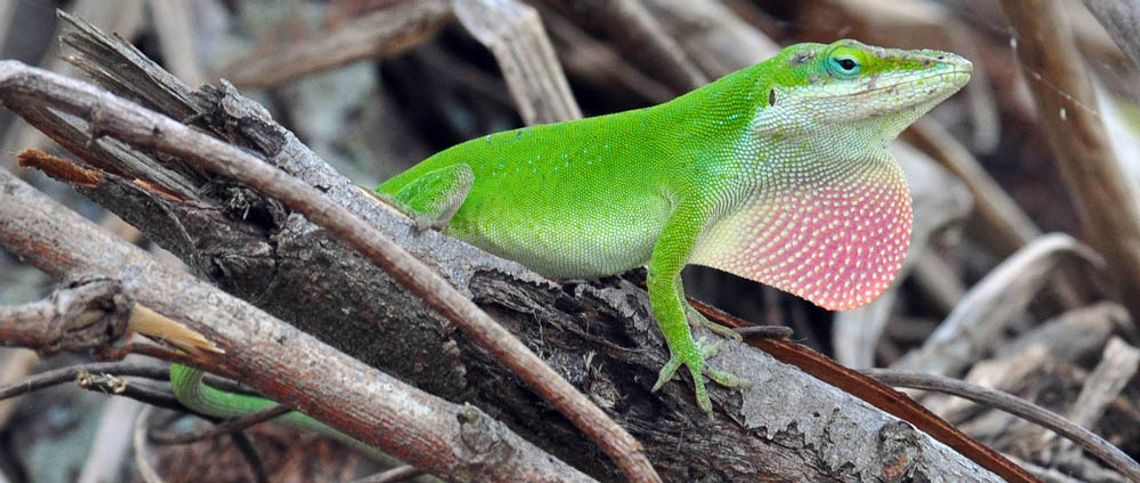
There are certain animals that elicit feelings of nostalgia back to a time when local dime stores and mail-order magazines would stock “chameleons” for those who were interested. While these little gems were sold as some exotic treasure, most folks didn’t realize that this animal was actually one that is common in Texas, the Green Anole.
The Green Anole (Anolis carolinensis) is one of two species of anoles that live in Texas, and it is the only native variety. Observations of this pretty little lizard are generally relegated to the eastern half of the state, with the Concho Valley area being the farthest range to the west. Elsewhere in the United States it can be observed throughout the gulf coast states and northward through parts of the Atlantic Seaboard.
The habitats that this colorful lizard prefers are arboreal settings in densely vegetated areas. Although occasional specimens are discovered foraging on the ground, the vast majority of sightings are of individuals in shrubbery and short trees. Many Green Anoles are observed living around landscaped human habitations such as houses and even businesses.
The Green Anole is among the most brilliantly colored and yet plain lacertilian species in the United States. The scales on the back are small and granular in appearance and texture, and it is one of the few lizards in the world that can undergo a complete change in color, hence the popular name in the southeast of American Chameleon. The background coloration varies from a bright green to a dark brown, all depending on a variety of environmental factors. Contrary to popular belief, neither this species nor the true Chameleons of the Old World change colors to match their surroundings. The Green Anole maintains a shade of various greens when relaxed while in times of distress or when the temperatures are below optimal it will hold various shades of brown. The elongated head is not noticeably separated from the body, and the tail, which is colored like the back, is about one-half of the six inch total length.
“American Chameleons”, like other lizard species, are “cold-blooded”, or ectothermic. This means that it does not generate heat from the inside of their body, as mammals and birds do, but rather is dependent on outside sources for heating and cooling. It is active during the early mornings and late afternoons from early April to October, and like many other reptile species it avoids the hottest part of the day by resting in shaded areas.
This species of lizard is an opportunistic carnivore, feeding primarily on small insects such as moths, butterflies, crickets, grasshoppers, beetles, and the like. Occasionally larger males will feed on smaller lizards, but this is rather rare in occurrence.
The Green Anole is oviparous, which is a fancy way of saying that it lays eggs. After emerging from the winter-long brumation period (reptiles do not hibernate in the true sense of the word), males will search out females to mate. During the breeding season, which is typically in early spring, males will attempt to attract females by extending his bright pink dewlap (a flap of skin underneath the chin) while bobbing his head in a “push-up” manner. After a month following a successful copulation, the female will begin to lay clutches of two eggs. As many as five clutches can be produced by a single mating session. These eggs are laid in areas of high humidity, and typically will hatch in about five weeks. The twoinch long hatchlings are colored identically like the adults, and are capable of fending for themselves immediately.
This lizard species is a gregarious basker and will often allow people to get rather close as it relies upon its coloration for protection. However, once it feels an intruder has approached too close for comfort, it will quickly dart for cover among the leaf litter.