
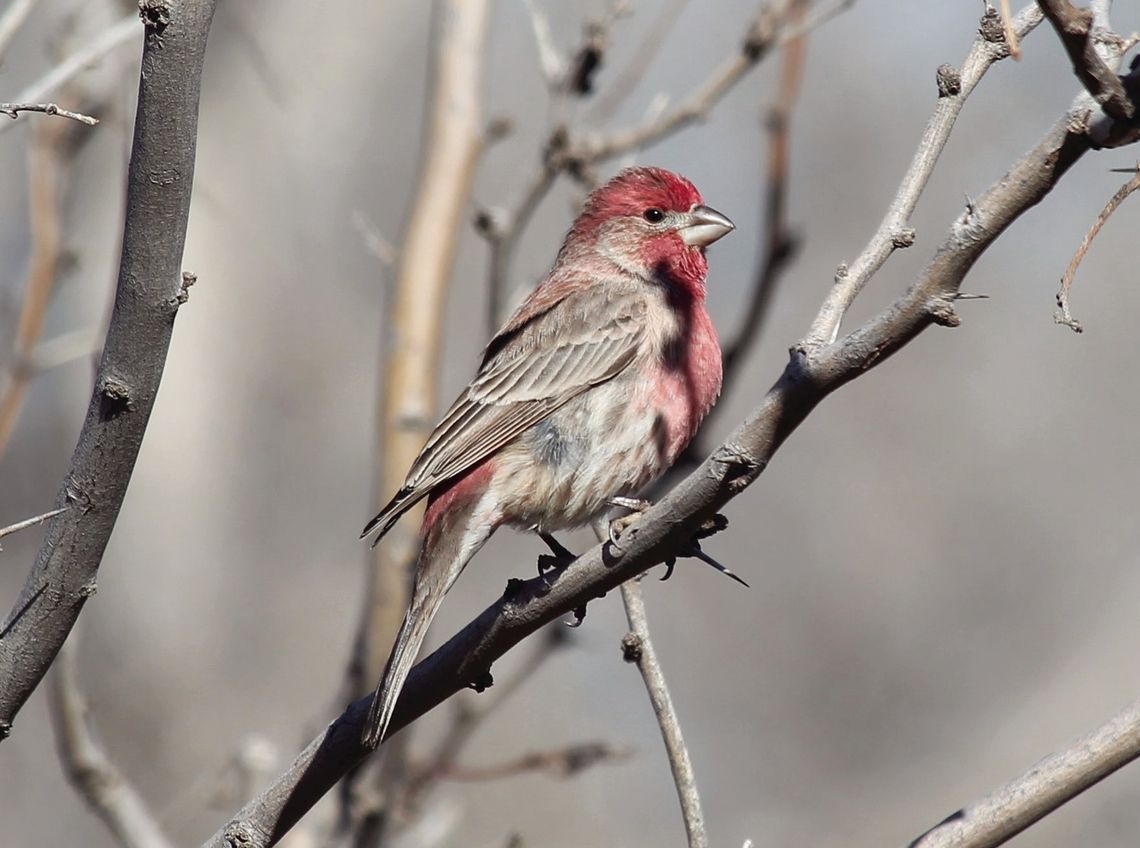
The House Finch (Carpodacus mexicanus) is unquestionably one of the mostbcommon, although lesser-known birds in North America, occurring in every state in the Union. This was not always the case however, for at one time it was restricted to the western United States. The first introductions in the east began in New York in the 1940’s, and from there it has spread rather rapidly throughout the remainder of the continental U.S. It is not a migratory species, which means that it can be observed here at any time of the year.
Adult males of this species are quite conspicuous with their colorful adornment of a bright ruby-red breast and face. The back and underparts are colored brown and decorated with lighter brown streaking. The wings are also streaked with black, and there are 2 narrow white wing bars. As is custom for the vast majority of songbirds, the female is by far the less colorful of the two sexes. Females have the same coloration on the back, wings, and underparts as the males, but they lack the brilliant colors on the head and chest area. Immature males are similar in coloration to the females. The tail is proportionately long and is squared in appearance.
It is a small bird, with a body length of about six inches and a wingspan that can approach ten inches.
House Finches are one of the most rambunctious and noticeable of all the avian species that occur in this area. Their calls vary from a simple chee to a series of multipletoned chee-wheet. It often hops on the ground in search of food items which include seeds, grains, nuts, and fruits as well as small insects. When flying, the flight pattern is easily recognizable as it is an up and down path with rapid wing beats alternated with short periods of gliding with the wings pulled to the sides of the body.
These birds typically prefer to live in social groups during the non-breeding season. During the breeding season, they known to pair up with the male and female remaining monogamous during such time. The nest is constructed by the female and is typically found in human structures such as the backs of advertising billboards, street signs, and bird boxes. It will occasionally utilize abandoned nests from other species of birds. The 2 to 6 eggs are small (roughly ¾ inch by ½ inch) and are usually colored a light blue with black spots that are found primarily on the larger end of the egg. These eggs hatch in about two weeks after being incubated by the female, and both parents share the responsibility of caregiving to the helpless young until they leave the nest approximately three weeks after hatching. Juveniles are colored similar to the adult females. Up to three broods per year have been recorded.
This avian variety is definitely one species of bird that has adapted quite well to human habitation, with many individuals seen foraging in lawns and gardens. They are not particularly bashful, and many will utilize bird feeders that are littered with seeds such as millet and sunflower. This species was first introduced to the eastern United States as a cage bird due to its dazzling colors.