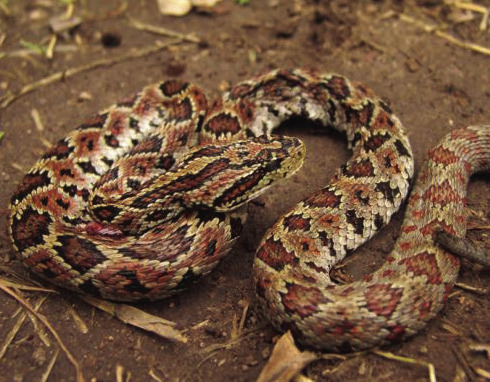
When I first began writing this column, my original premise was to focus on animals that are found right here in the “backyards” of Texas. Thus far, I have stayed true to this focus. However, there was a huge scientific discovery made recently along the western coast of Mexico involving a species of rattlesnake that I just have to share.
The story begins in 1966 when a small rattlesnake was found dead on a road in the Mexican state of Jalisco. It was given the name Autlan Long-tailed Rattlesnake (Crotalus lannomi). This specimen was the first of its kind, and it was deposited in the Brigham Young University museum collection. Because there was a tremendous amount of flora and fauna being discovered during that time, not much was thought about this unusual specimen. But over the next four decades, no more specimens (living or dead) reappeared. Many professional and amateur herpetologists spent countless man-hours in the field looking to procure the first living specimen of this rattlesnake.
As an avid herpetologist with a fascination with rattlesnakes, I even made the journey to Salt Lake City, Utah to see this “holy grail” of rattlesnakes with my own two eyes. Even though it was a just preserved specimen, I was lucky enough to be able to have my photo made with it in my hands.
Then in 2009, while on a field trip to Mexico my friend and my guide to the area was showing off his rather extensive digital photograph collection of various species of rattlesnakes. He proceeded to ask if I would like to see a photograph of a most unusual rattlesnake, and in my mind I thought that perhaps he had an albino rattlesnake or a specimen with some other genetic abnormality. To my utter amazement, he showed me photographs of not one, not two, not even three, but of five LIVING Autlan Long-tailed rattlesnakes! He and his partners had spent the better part of four years in the field searching for this creature of mythical proportions, and their time, patience and fearlessness had paid off.
The five known living specimens of the Autlan Long-tailed Rattlesnake were observed in two separate fields along the western slope foothills of the Sierra Madre Occidental in the state of Colima, Mexico. These areas are primarily made up of an oak forest and tropical deciduous forest combination, meaning that there is heavy underbrush and ground cover, providing this secretive species ample areas in which to hide. The area is also known to be quite lawless, as the soil and weather are conducive for the growth of certain “crops”.
This is a small species of rattlesnake that apparently attains an adult length of about 18 inches, with the record size being just over 25 inches.
Long-tailed rattlesnakes are similar to more familiar rattlesnakes in that they have a rattle segment at the end of the tail that makes the tell-tale buzzing noise as the snake nervously vibrates its tail. However, in this species the rattle is described to be rather petite, almost non-existent. If a person were to hear this rattle clearly, it might be possible that they could be bitten on the ear! The body is long and slender, with the background coloration shades of browns and yellows. Along the spine, there are between thirty-one and thirty-five dorsal blotches that are rusty colored set off by a dark then light colored border. These blotches are most prominent in the front two-thirds of the body. The tail is disproportionately elongated, (hence the common name) while the head is long and narrow.
The natural history is, for obvious reasons, virtually unknown. It apparently feeds on lizards and small mammals that are subdued by the venom that it possesses. All five live specimens were discovered between 11:30am to 1:00pm, although they almost certainly roam at other times as well. Reproduction is unknown, although they are bound to give live birth like other rattlesnake species. The temperament has been described as being “quick to rattle and retreat” and they did not assume the standard “defensive” stance that many rattlesnakes employ to intimidate potential predators when encountered in the field.
Like many people, I have my desk adorned with photos of personal importance such as family, celebrities, and animals. Now it appears that I will have to remove the photo of me holding the “only” known Autlan Longtailed Rattlesnake. That’s alright, because now I can replace it with a photo of a living specimen.