
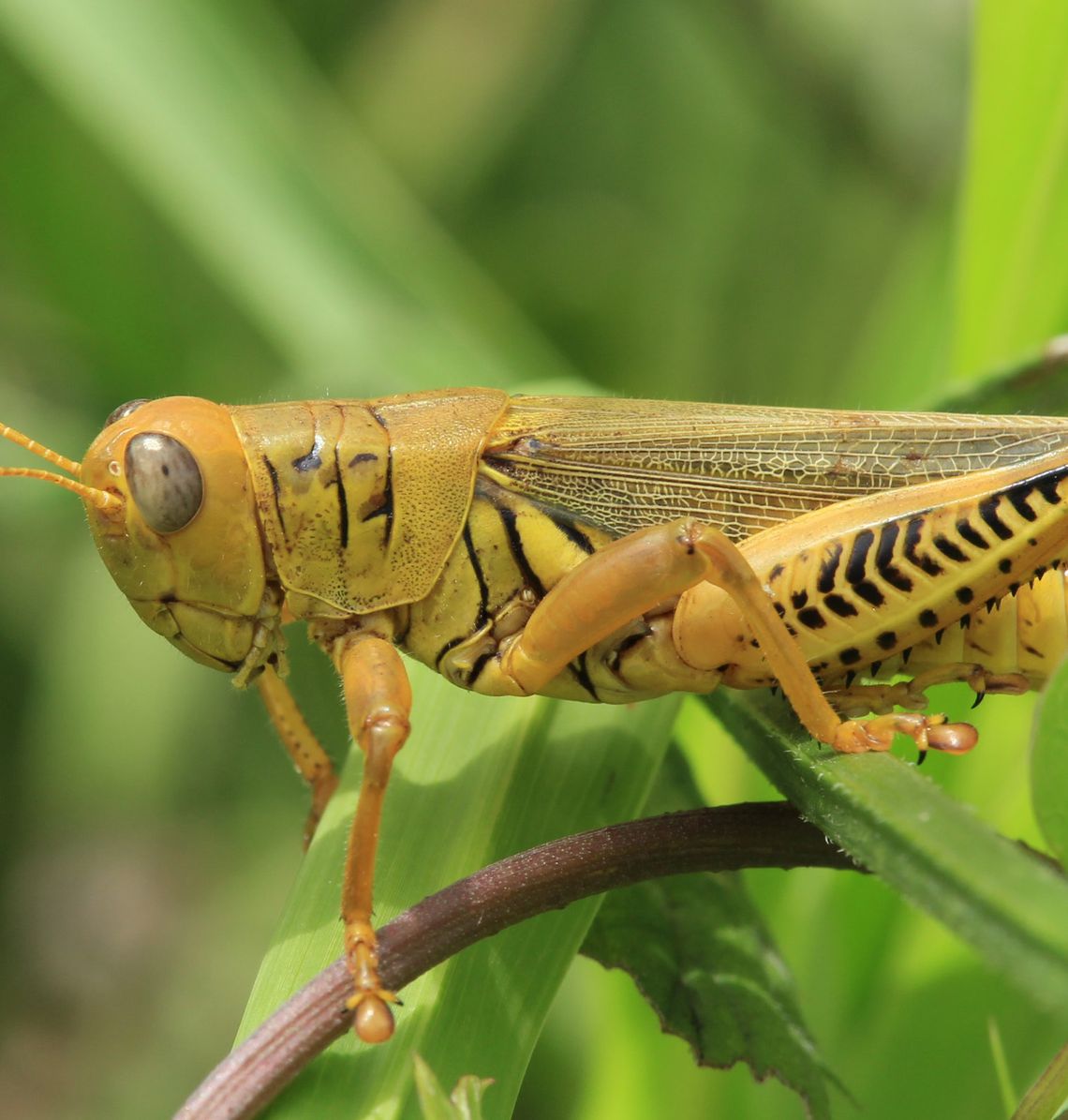
Grasshoppers of various species can be observed throughout this great state. Many are obscure and unassuming while others can be boldly marked and striking. Some varieties are harmless to man-made crops and other plants while some can destroy a crop with a single swarm. One such grasshopper that is boldly marked as well as being known as a crop destroyer can be observed throughout this state, and that species is the Differential Grasshopper.
The Differential Grasshopper ( MELANOPLUS DIFFERENTIALIS) is one of the largest and most recognizable grasshoppers that can be seen in this state. It can be observed throughout Texas, and outside of Texas it can be observed from central Mexico northward to the Dakotas eastward to the east coast of the Carolinas. It is largely absent from the Gulf states as well as most areas west of the Rocky Mountains.
Differential Grasshoppers are grasshoppers, and grasshoppers are insects, and like others of this group, they have three body parts: the head, the thorax, and the abdomen. Each one of these body parts has a specific purpose, with the head being the area where the eyes and feeding appendages are, the thorax is where the legs and wings are attached, and the abdomen is where the majority of the internal organs are housed. Also, like others in the insect group, the skeletal structure is on the outside of their body. This structure is known as the exoskeleton. They have six legs, as well as two pairs of wings and two antennae.
This particular species of grasshopper can be quite brightly colored or extremely muted in coloration. Typically, the three body parts of most specimens are various shades of yellow although some are olive or even blue green. The hind legs are long, adorned with black blotches and have very sharp spines along the edges. The eyes range in color from yellow to black to gray. The wings either match the color of the body or are slightly darker. Males and females are similar in most respects save for the size. Males only attain a length of just under 1 ½ inches while females (the larger sex) can attain a total length of two inches.
Across most of the United States, this variety of grasshopper produces one generation of young annually, albeit with females laying up to six egg masses. In each egg mass, there can be anywhere between 100-200 eggs, so each female can produce upwards of 1,200 young annually. The eggs are laid during the summer months, where they will stay until the following summer when they hatch during a two-week period. It can take only one month for the young (known as nymphs) to reach adulthood.
Although it feeds primarily on native sunflower leaves and other broadleaf plants, adults of this species have been known to decimate cotton and corn crops while the young will feed on hay and various grains. As such, this species is considered to be a serious pest to farming over most of its range.
But all is not lost with this species. Despite it being classified as a serious pest to crops, it is also famous for being a tremendous bait for fish. Many fishermen can tell stories of maxing out their limit on various species of game fish while utilizing Differential Grasshoppers as bait.