Texas A&M trio leads new frontier in horticultural science
At a time when agriculture must feed more people with fewer resources, a trio of scientists are transforming the future of horticulture.
New researchers Ahmed Darwish, Ph.D.; Lorenzo Rossi, Ph.D.; and Andrej Svyantek, Ph.D., in the Texas A&M College of Agriculture and Life Sciences Department of Horticultural Sciences are reimagining how plants are studied, bred and grown.
Together, they represent a new generation of research that looks beyond yield – focusing on crop resilience, resource and environmental stewardship, and added human health benefits from the food we grow.
“Yield potential will always be a part of the equation in our efforts to produce improved horticultural crops,” Amit Dhingra, Ph.D., head of the Department of Horticultural Sciences said. “But the new frontier also ensures our horticultural crops are resilient against stresses like pests, disease and drought; more efficiently use inputs like water and nutrients; and are beneficial to human wellness.”
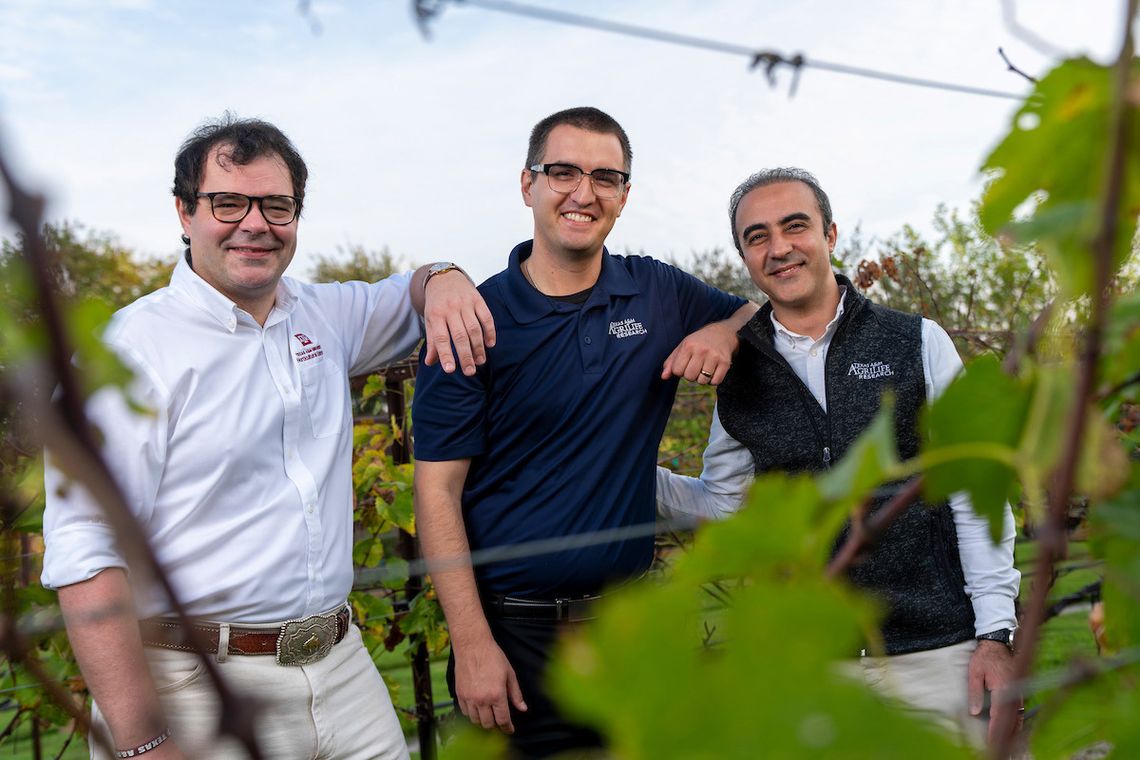
(Left to right) Research programs established by Lorenzo Rossi, Ph.D., Andrej Svyantek, Ph.D., and Ahmed Darwish, Ph.D., in the Texas A&M Department of Horticultural Sciences are part of a shift toward innovative and impactful solutions related to economic and environmental sustainability, food security and human health and wellness. (Michael Miller/Texas A&M AgriLife)
Three researchers, one mission
The researchers arrived at Texas A&M University in the past 18 months as a strategic plan to brings complimentary expertise that bridges plant genetics, physiology and chemistry.
Their collective expertise reflects the department’s focus on ensuring economic and environmental sustainability for growers, advancing food security through regionally resilient cropping systems, and addressing public health and wellness through nutrition-rich crops.
For instance, Darwish is testing blueberry extracts that modulate gut health to improve cardiovascular health and fight inflammation and chronic diseases like obesity and cancer.
Rossi is investigating how regenerative horticultural practices, like adding organic matter to pecan orchards, can improve soil health, boost yields, and reduce the need for fertilizers and pesticides.
Svyantek is mapping genetics in wine grape vines to drive vineyard sustainability by discovering new sources for disease resistance and environmental ruggedness.
Creating new cultivars for farmers that tolerate Texas’ weather challenges and withstand pest and disease pressure will help reduce producers’ input costs while also leading to healthier crops at harvest.
“What we do is rooted in the land-grant mission that we need to address real-world problems that come from growers — because they’re the ones who live these challenges every day, and they’re the ones our research is meant to serve,” Rossi said. “But that work and the crops growers produce also serve a greater good for all of us, for our natural resources, and that is why our efforts circle back to food security, sustainability and wellness.”
Advancing horticultural science for a healthier planet
Since arriving, the researchers have thrived in the collaboration-rich research, extension and teaching environment. They believe building their respective programs around the same time has helped coalesce their collective approach to research projects.
Their work enhances Texas A&M’s horticultural sciences program as a hub for innovation in fruit breeding, health-driven crop research, and profitable and environmentally sustainable production systems.
Together, they are developing ways their collective expertise can enhance collaborative projects to provide impact from seed to grocery shopper. They have also revamped some older courses and developed new ones to prepare the next generation of successful horticulture professionals.
They are engaging with experts within and outside the Department of Horticultural Sciences as well as external academic, industry and agency partners. For instance, each has had individual success with grant proposals but are collaborating on proposals representing broad impacts for producers as well as consumers.
“Our goal is to advance horticultural science in ways that translate to producer success and better experiences and outcomes for the people consuming their crops,” Darwish said. “What we do has the potential to impact along every step from farm to table.”
Texas: A plant researcher’s playground
Beyond the collaboration- rich environment at Texas A&M, the trio are also finding Texas’ climactic diversity, soil types, water sources and season-toseason extremes make an ideal testing ground for new horticultural crop varieties.
Svyantek said Texas environments, from humid East Texas to the arid High Plains, offer unique opportunities to test crops under a wide range of conditions. Regional climates, soil types, pH levels and water salinity along with regional pest and disease threats create a mix of challenges that can vary greatly from season to season. This means plants that perform well under conditions at a regional research site around the state could be successful in other parts of the world.
“Texas can be viewed as the toughest-case scenario in terms of growing conditions for much of the world,” Svyantek said. “And so, when we make plants that are going to survive and thrive here, it translates into the potential success for growers in many parts of the world.”
By developing cultivars that thrive in Texas, Dhingra said the department is providing solutions relevant to growers self-reliance across the U.S. and beyond.
“These three researchers elevate what we are doing across our horticulture research and teaching programs,” Dhingra said. “This is the right time, and Texas is the right place to pursue research that positively impacts our producers and consumers but that can also ripple globally across those sustainability, food security and wellness pillars.”