
Sometimes the common names that taxonomists place on animals can be a bit misleading.
For example, the name Common Snapping Turtle insinuates that species is, well, common when the opposite is more accurate. Or the name Western Cottonmouth suggests that species can be seen in the “west” when in actuality, its natural range barely extends into the Hill Country of Texas. But at times, the animal being classified by a common name does fit the description, and one species of amphibian whose natural range barely extends into this state is a good example of such.
The Giant Toad ( Rhinella horribilis) is one of 10 species of “true” toads that occur naturally in Texas. Of those 10 species, it has the second smallest range; only the endangered Houston Toad has a more restricted range.
It can be observed only in a small zone in the extreme southern section of the state; basically, from Laredo eastward to Hebbronville and then diagonally southward to Brownsville. Outside of the United States it is a common sight along both coasts of mainland Mexico southward through Central American to the eastern coast of South America in Ecuador.
Despite such a large natural range in the tropics, it prefers to reside in urban and agricultural areas of south Texas. It seems to congregate in areas where artificial nighttime lighting will attract large numbers of insects.
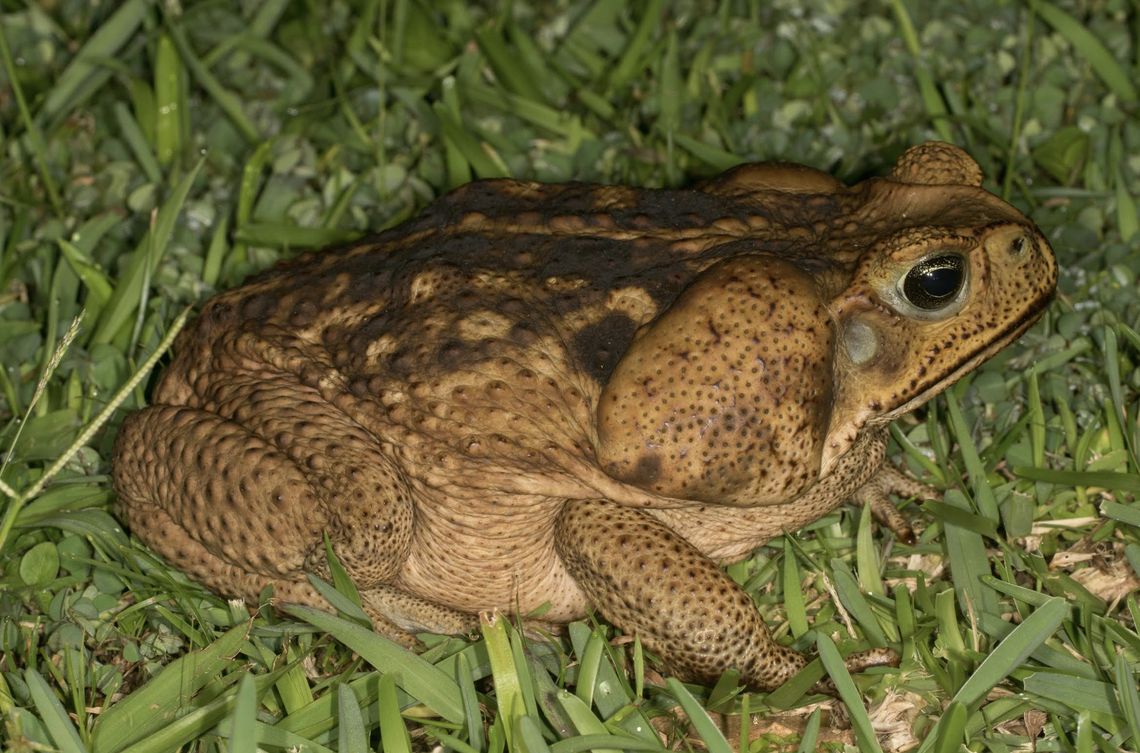
The Giant Toad is a robust amphibian that has dry, wart-covered skin. The background coloration can vary from any shade of brown to almost red. It usually, although not always, has a fair amount of black mottling and darker spots along the back. Generally, the females have the most amount of pattern.
The size of the parotoid glands, the large “bumps” immediately behind each eye, are a distinctive diagnostic characteristic of this species. Whereas most toad species in Texas have parotoid glands that are slightly larger than the eye, in this species the toxic filled glands are disproportionately huge, sometimes larger than the head of the individual toad itself.
As the common name implies, the Giant Toad is a truly massive toad species. Adult females, the larger sex, can approach lengths of just over 7 inches from the snout to the end of the body. That dwarfs the next largest species of toad in this state by almost 3 inches!
Giant Toads, like other amphibian species, live a dual life. In fact, the word amphibian itself means “double-life”.
When the spring and summer rains begin, males of this species will congregate at shallow pools to begin to attract a mate. This attraction consists of males calling in slow, pulsating, lowpitched trills. When just one or two males are calling, the noise is nothing more than background noise. However, when a large group begins to call in a chorus, the noise can be deafening.
Once a male successfully attracts a mate, they engage in the process of externally fertilizing the eggs. This process is known as amplexus.
During this time, a male will wrap his forelegs around a receptive female and as she lays her eggs, he will fertilize each individual one as it exits the female’s body.
A tremendous number of eggs may be laid during each breeding session, with nearly twenty thousand at one time being reported, and the number of sessions may vary from two to three annually to once every two to three years. Breeding is all based upon sufficient rainfall, for the eggs are often laid in shallow, non-permanent pools of water that dry up after just a few sunny days accompanied with unbearable heat.
The life cycle of the Giant Toad continues as the fertilized eggs hatch into tiny, dark tadpoles.
These tadpoles are often referred to as “pollywogs”. They are fish-like in appearance, and they obtain their oxygen from the water through gills.
Within a day or two after hatching, they begin a miraculous metamorphosis where their lungs begin to develop, while at the same time, back legs begin to form on their bodies. Within the next day or two from then, front legs begin to appear, the tail begins to shrink, the lungs continue to develop, and the back legs become larger.
This process continues for about a week after hatching, when the tiny toadlets have completed their change, looking like tiny replicas of the adults, thus beginning their “second” life.
This species is highly predacious, and it feeds on large amounts of insects when moisture levels are at a sufficient level to prevent desiccation; therefore, they are beneficial to agriculturally based ventures such as crops or gardens. It will also not hesitate to feed on smaller native frogs and toads as well as other arthropods. It has been known to even feed on cat or dog food that has been left outside.
Many myths surround toads, and the most common tale is the notion that toads cause warts on people if handled. This is not true of course, but rather, the secretions that are present when a toad is handled are either the poison from the parotoid glands, or urine as the toad is frightened. The poison of the Giant Toad is apparently not harmful to humans, but it has been connected to the deaths of dogs and even some natural predators, so caution should be exercised if this species is to be handled for any reason.