
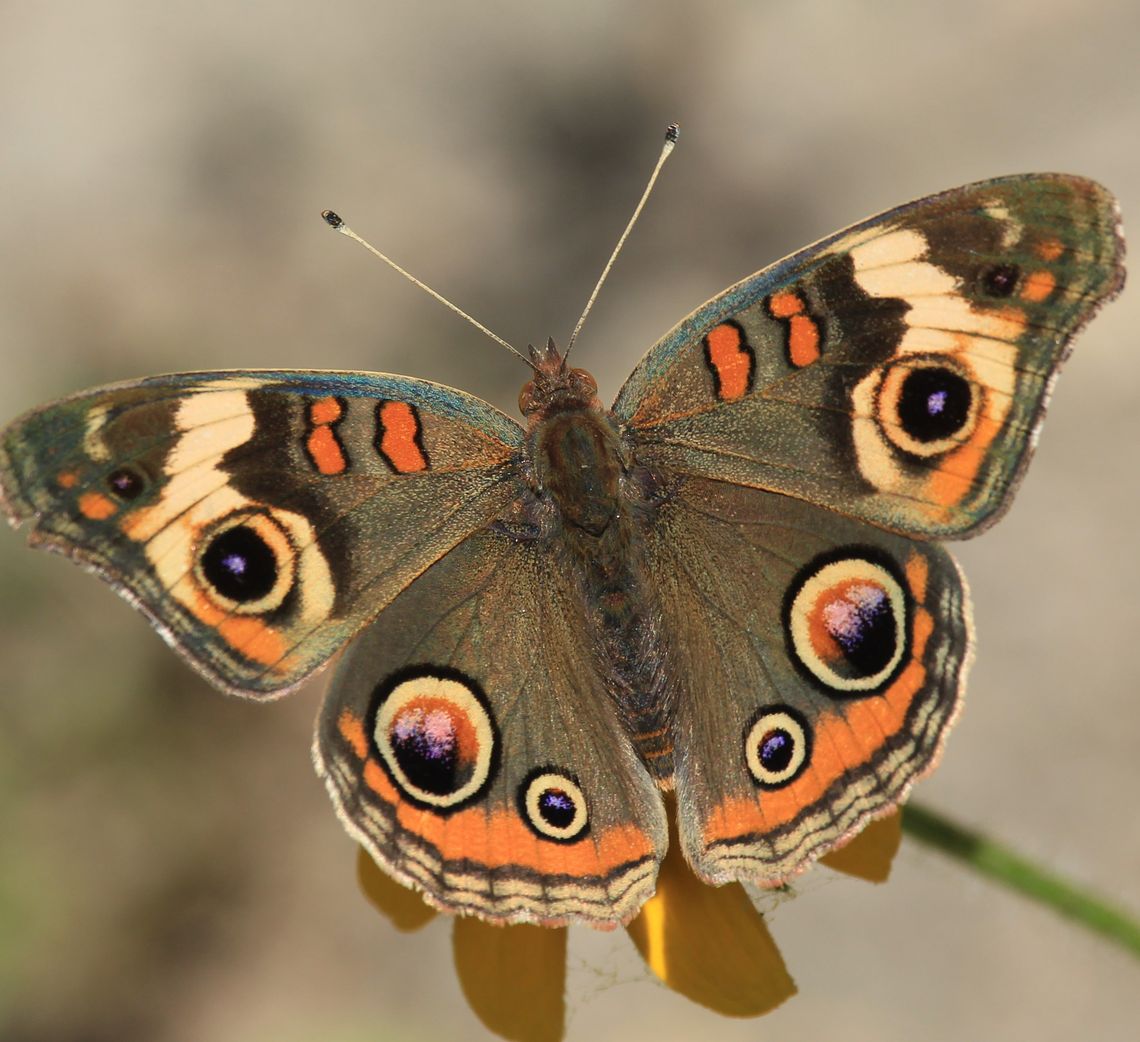
There are many, many word duos that simply belong together. Examples include Bacon and Eggs. Batman and Robin. Day and Night. Give and Take. Cough and Covid. (Sorry, couldn’t resist!) But one word duo that flows together quite easily but for whatever reason is not as “well known” as the others is Nature and Art. But those who take a closer look at nature will undoubtably take notice that the colors and patterns exhibited can only be described as works of art. And there is a familiar species of butterfly known as the Common Buckeye that is a prime example of nature and art woven together.
The Common Buckeye ( Junonia coenia) has a widespread distribution that is primarily in the eastern half of the United States and Mexico. This same delineation occurs in the state of Texas, although there have been numerous observations of this species in and around urban areas and the higher elevation mountains of western Texas.
Attempting to adequately describe the Common Buckeye would be akin to briefly describing Andrew Wyeth’s Christina’s World. The background coloration is brown, although with the splashes of a vast array of colors, this background coloration is hardly noticeable. The most distinguishing characteristic of the Common Buckeye is the large black and gold bordered “eyespots” that contain the colors blue, black and orange. There are four “eyespots” on the hindwing and four on the forewing, but the ones on the hindwing are larger and more striking. The purpose of these eyespots may be to ward off predatory birds.
Additional characters include white blotches near the tips of the forewings as well as four black-bordered, orange-colored bars on the forewings as well. The posterior portion of the hindwings is outlined with black, yellow, and orange lines. Combining these beautiful colors with a wingspan of nearly two and one-half inches makes this species an impressive sight to behold.
Preferring open fields, look for this species in sunny locations such as grasslands, woodland clearings in riparian areas and canyon bottoms. Adults feed primarily on the nectar of a variety of flowers while the larvae feed on foxglove, snapdragon and ruellia.
Adults utilize an appendage known as a proboscis to feed on these items. The proboscis is long and almost threadlike, and in times of nonuse is curled up under the head of the butterfly.
Common Buckeyes, like other butterfly species, undergo a fourstage life cycle that can be described as nothing short of miraculous. In the beginning stage, their life begins as an egg, which hatches after a few short days into the next stage. Upon hatching, the larvae are known as caterpillars, and at this stage, the growth rate is highly accelerated. Caterpillars can eat twice their body weight in a single day, and as such, grow quickly. As they grow, they literally grow out of their skins, and they shed their outer layer of skin up to five times (known as molting) before they enter the next stage of their life cycle. After the caterpillar finds a spot in which it feels is secure, it will pupate as it forms a protective shell about it known as a chrysalis. Inside of this shell, the larvae changes into the butterfly that it will soon become. After about a week, the adult will emerge from this shell with its wings intact, although they are crumpled into small balls on the sides of the body. The butterfly will then pump a clear fluid into the veins of their wings, causing them to expand much the same way a stick can reinforce a kite.
In a not-so-incongruous event, given the artistry of this species, it bears the specific epithet of either Jan Henri de Coene or Constantinus Fidelio Coene, both of whom were notable canvas painters from France.