
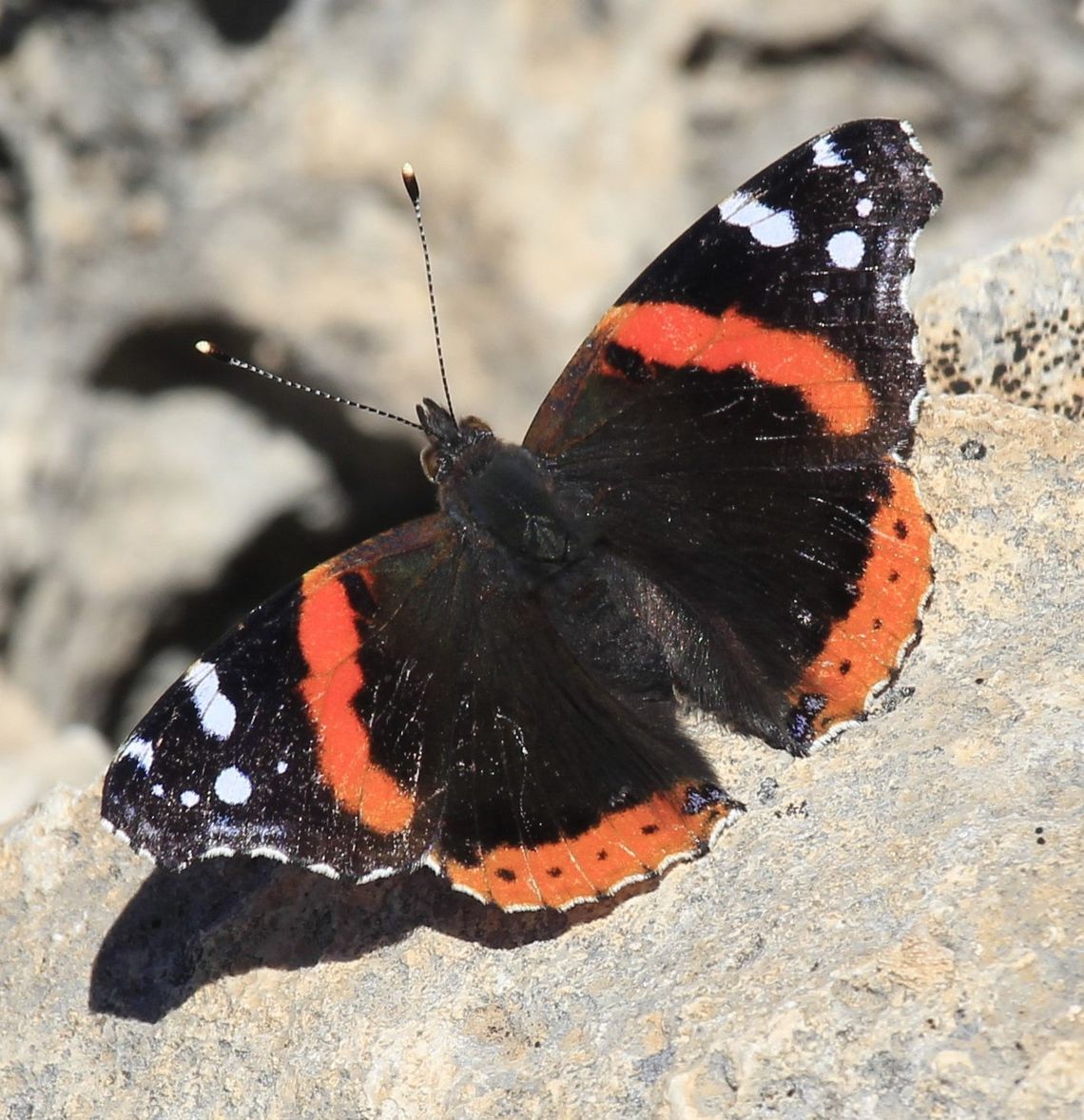
In the animal kingdom, there are oftentimes creatures that are visually similar to one another. For example, three of the four species of Lady Butterflies that reside in Texas appear very closely related to one another in both color and pattern. However, there is that fourth species, the black sheep of the family as it were, whose appearance is virtually nothing like the other three species, and that variety is the Red Admiral.
The Red Admiral ( Vanessa atalanta) is a familiar butterfly whose natural range encompasses the entire continent, obviously including the entire state of Texas. It is one of four species of “ladies” to call Texas home, and as I mentioned above, it is the most distinctive of the group. It does not appear to favor one type of habitat over another, but rather is a habitat generalist, thriving in natural and feral forests, plains, grasslands, mesquite thornscrub, and even urban backyards.
This medium sized butterfly (wingspan of two inches) is like many other butterflies in that the above wings and below wings look entirely different from one another. The above forewing is bicolored with brown close to the body and black on the wing tip; these colors are separated by an orange stripe. The black wing tips are marked with sharply contrasting white dots. The above hindwing is also brown, but the lower quarter of the wing is orange with small black spots that are close to the edges. There are two small blue spots on the interior of each hindwing. The body is brown and the antennae are black with white tips.
The below forewing, seen when the wings are closed, has a large pink patch in the middle of it. This pink patch is followed by a smattering of blue and white dashes towards the wingtips. The below hindwing has a network appearance of brown and blue lines.
Like other members of the Lady Butterfly group, as an adult, this type of butterfly feeds on a variety of nectars. It differs in the fact that it will also feed on sap, rotten fruits, decaying flesh and even animal waste. It utilizes an appendage known as a proboscis to feed on these items. The proboscis is long and almost threadlike, and in times of non-use is curled up under the head of the butterfly The Red Admiral, like other butterfly species, undergoes a four-stage life cycle that can be described as nothing short of miraculous. In the beginning stage, their life begins as an egg, which hatches after a few short days into the next stage. Upon hatching, the larvae are known as caterpillars, and at this stage, the growth rate is highly accelerated. Caterpillars can eat twice their body weight in a single day, and as such, grow quickly. Red Admiral caterpillars feed primarily on flowers in the Aster family. As they grow, they literally grow out of their skins, and they shed their outer layer of skin up to five times (known as molting) before they enter the next stage of their life cycle. After the caterpillar finds a spot in which it feels is secure, it will pupate as it forms a protective shell about it known as a chrysalis. Inside of this shell, the larvae changes into the butterfly that it will soon become. After about a week, the adult will emerge from this shell with its wings intact, although they are crumpled into small balls on the sides of the body. The butterfly will then pump a clear fluid into the veins of their wings, causing them to expand much the same way a stick can reinforce a kite.
The namesake of the Red Admiral is a bit confusing. It belongs to the Lady group of butterflies and not to the family of butterflies known as Admirals. The namesake is thought to have originated from the fact that in England (where it also resides), it was initially known as the Red Admirable. In time, this name was replaced with the current namesake, Red Admiral.